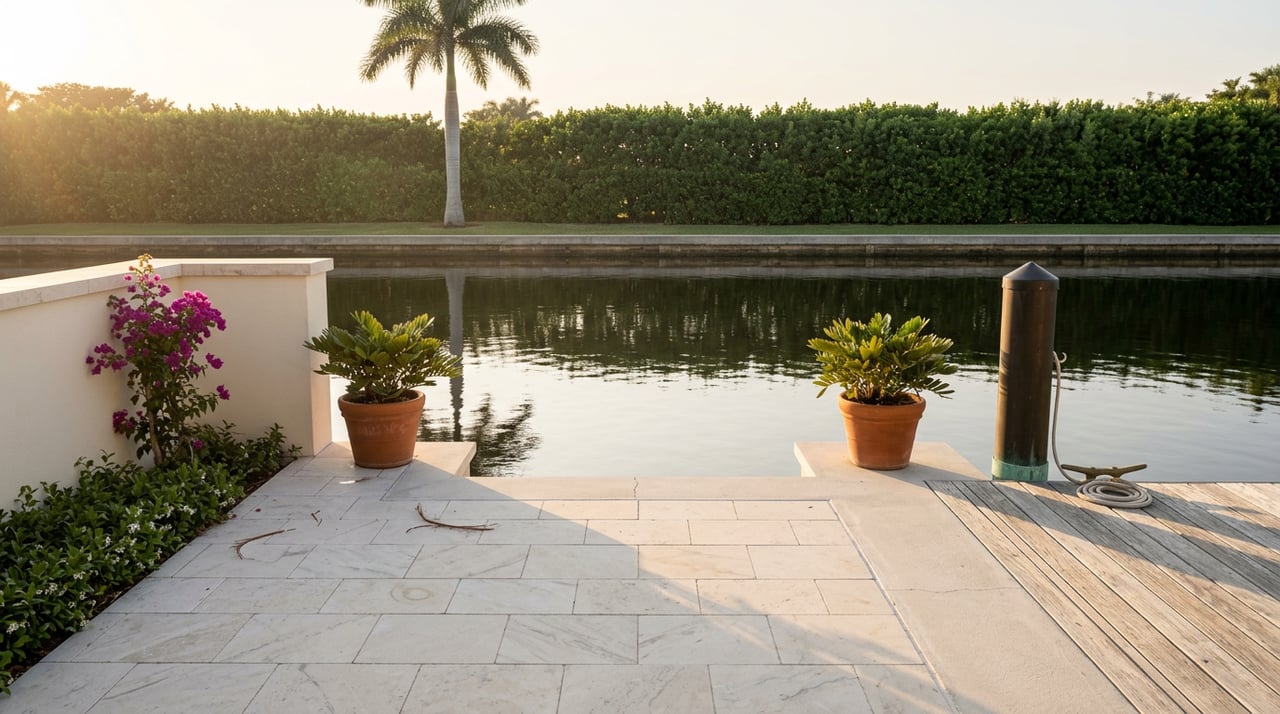
Fort Lauderdale Waterfront Seawall Inspection Guide
August 27, 2026
August 27, 2026
Walk a listing agent's open house on Rio Vista's Ponce de Leon Drive or one of the finger islands off Las Olas Boulevard, and the conversation follows a script. How many feet of frontage. Fixed bridges or none. Boat lift capacity. Price per square foot against the last comp on the street. These are the numbers that get repeated in the driveway, and they are not wrong to ask about. They are just not the number that decides whether the deal closes cleanly.
That number is five. Specifically, five feet of elevation, measured against the NAVD88 vertical datum, which is the height Broward County now requires for any tidal flood barrier, including the seawall standing between a buyer's new backyard and the canal. A wall can be structurally sound, freshly capped, and photograph beautifully, and still sit below that line. Whether it does determines what happens the next time that wall needs any real work.
Broward County's tidal flood barrier standard was built specifically with neighborhoods like these in mind. The regional elevation requirement came out of a joint study between the county and the U.S. Army Corps of Engineers that focused on two tidally influenced areas prone to nuisance flooding, one of which was the Las Olas Isles area in Fort Lauderdale. The resulting rule requires new or substantially repaired seawalls, banks, and berms to reach a minimum of five feet NAVD88. There is a softer on-ramp: applications filed before January 1, 2035 can use four feet NAVD88 instead, provided the design can still reach five feet by January 1, 2050. That second date matters more than it looks. A wall permitted today at the interim height still carries a future compliance obligation baked into the property, one that outlives the current owner's mortgage and, in some cases, the current owner's ownership entirely.
The part that catches buyers off guard is how the rule gets triggered. Failure to maintain a tidal flood barrier is a citable offense under the county code. Once cited, the owner has sixty days to show progress and 365 days to complete repairs. If the work meets the threshold for "substantial repair," meaning it touches more than half the property's shoreline length or the appurtenant work exceeds half the cost of the barrier itself, the owner has that same 365-day window to design, permit, and fully rebuild to current code, not patch to the old one. A storm, a dock replacement, or a routine repair that happens to cross that 50 percent line can convert a modest maintenance job into a full seawall reconstruction on a hard deadline.
Once a wall crosses that line, the numbers change quickly. Published estimates across South Florida marine contractors put new seawall systems at roughly $175 to $400 per linear foot, with the final bill shaped by water depth, soil conditions, and whether an old wall has to come out first. On a typical single-family lot, that translates to a wide range depending on scope.
| Item | Typical range | What drives the cost |
|---|---|---|
| Full seawall replacement | $15,000 to over $100,000 | Linear footage, material, demolition of the old wall, water depth |
| Pre-purchase seawall survey | $1,500 to $3,000 | Access, wall length, whether a diver inspection is needed |
| Annual seawall maintenance | $2,000 to $5,000 | Material, exposure, age of the wall |
| Dock replacement | $15,000 to $60,000 | Length, decking material, shore power and lighting |
| Annual dock maintenance | $1,000 to $3,000 | Hardware wear, cleaning, treatment |
Material choice adds another layer. Vinyl sheet pile walls have become the practical default for canal and Intracoastal-adjacent properties in Broward, corrosion-resistant and typically good for twenty to thirty years, while concrete remains the stronger choice for open water and direct ocean exposure. Marine contractors who work these canals regularly point to something specific about Fort Lauderdale's geography: finger canals that do not flush well, combined with heavy boat traffic on the New River and Intracoastal, accelerate rebar corrosion in concrete walls faster than in calmer waterways. Properties along the New River corridor and Las Olas Isles tend to show that wear earliest.
Here is the part most home inspections do not catch. A general inspector looks for what is visible: cracking, leaning, a deteriorated cap, a void behind the wall. Those are real warning signs, and they matter. But a wall can show none of them and still sit below the current elevation standard. Elevation compliance is not a visual defect. It requires pulling permit records or commissioning a marine-specific survey that checks the cap height against NAVD88, something a standard four-corners home inspection is not built to do.
That gap is exactly why a seawall that looks fine in every listing photo can still be a liability. The wall is not failing today. It is compliant enough to stand. But it is one storm, one dock project, or one neighbor's permit application away from a citation that starts the clock on a rebuild the current price never accounted for. Buyers who stop at "does it look okay" are answering the wrong question. The right one is whether the wall's documented elevation already meets the five-foot standard, or is still riding the four-foot interim allowance toward a 2050 deadline that will eventually need funding.
This is not a hypothetical rule sitting in a code book. The City of Fort Lauderdale has been rebuilding public seawall to the new standard for several years now. Along Las Olas Boulevard in the Las Olas Isles neighborhood, the city worked with Poseidon Dredge & Marine to replace several hundred feet of city-owned seawall in overlapping segments, each rebuilt with a cap elevation of five feet NAVD to reduce tidal flooding during king tides. More recently, in the spring of 2025, the city treated a failing section of seawall in Bay Colony as an emergency, contracting with David Mancini & Sons to replace roughly fifty feet of wall along Bayview Drive, with a follow-on project planned to extend the work toward NE 59th Street.
There is also a lever working in sellers' favor right now. As of this past May, The Church by the Sea, on Fort Lauderdale's barrier island east of the 17th Street Causeway, was moving toward breaking ground on a "living seawall" project to rebuild nearly a thousand feet of decades-old wall, with completion targeted for spring 2027, using a design meant to filter canal water while meeting the elevation standard. The city's new living-seawall incentive program covers up to 100 percent of the permitting fees for projects built this way, a detail worth raising with any seller whose wall is already due for work, since it can meaningfully offset the cost side of a negotiation.
None of this shows up as a line item on a listing sheet, which is why it gets missed until an appraisal, survey, or insurance quote surfaces it mid-contract. In the twelve months ending May 2026, Rio Vista saw 24 homes change hands at an average asking price of roughly $2.33 million against an average selling price near $2.16 million, a 93 percent list-to-sell ratio, and an average of 119 days on market at about $734 per square foot. Those numbers describe a market where well-priced, well-documented homes move efficiently and everything else sits. A seawall with an unresolved elevation question is exactly the kind of unresolved detail that stretches a listing past that average, because it surfaces during due diligence rather than before the home ever hits the market.
Asking for these five things before drafting an offer moves the seawall question from a post-contract surprise to a pre-offer negotiating point, which is a materially different position to be in.
If my seawall passes today, can I ignore the five-foot standard entirely? Only until the wall needs substantial repair or the property changes hands into a new permit application. The elevation requirement attaches to the wall's next major work, not to the calendar, so a compliant-looking wall today does not exempt it from the standard once repair work crosses the substantial-repair threshold.
Is vinyl or concrete the better choice for a typical Fort Lauderdale canal lot? For most residential canal and Intracoastal-adjacent properties in Broward, vinyl sheet piling is the more common and cost-effective choice given its resistance to corrosion and twenty-to-thirty-year lifespan. Concrete remains preferable for direct ocean exposure or where maximum structural mass is needed.
Does the four-foot interim allowance mean I can put off the cost indefinitely? No. Permits filed under the interim option still have to be designed to reach five feet NAVD88 by January 1, 2050. It defers the immediate expense, not the eventual one.
A waterfront closing in Fort Lauderdale rarely stalls over the price. It stalls over a detail nobody priced in. If you are buying or selling on Rio Vista, Las Olas Isles, Seven Isles, Harbor Beach, or Bay Colony, Roi Danon can help you get the seawall question answered before it becomes a renegotiation, not after. Request a Free Concierge Consultation to start with a property-specific read on what your wall, your dock, and your insurance quote actually say about the deal in front of you.
October 1, 2026
September 24, 2026
September 17, 2026

September 10, 2026
September 3, 2026
September 3, 2026
August 27, 2026
August 20, 2026
August 13, 2026
Get assistance in determining current property value, crafting a competitive offer, writing and negotiating a contract, and much more. Contact me today.