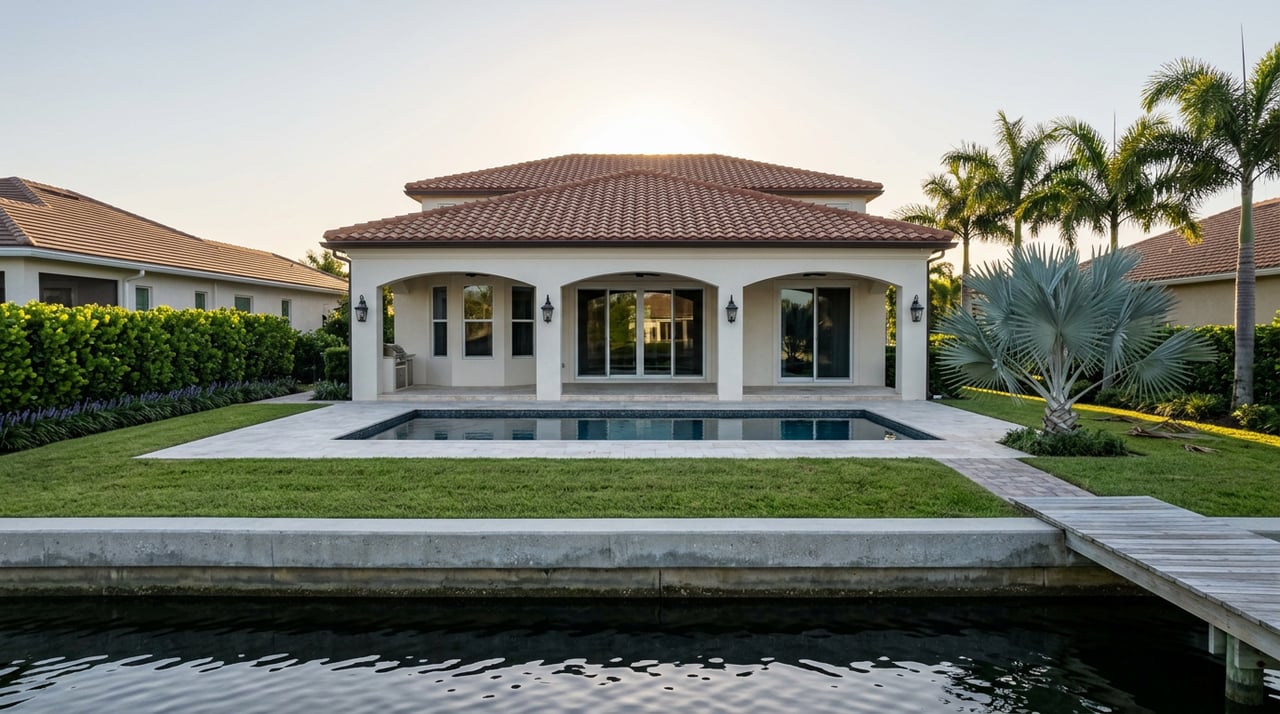
The Fort Lauderdale Seawall Rule That Turns a Repair Into a Rebuild
September 24, 2026
September 24, 2026
The quote was supposed to be simple. A Rio Vista homeowner calls a marine contractor about a section of cracked cap on the finger canal behind the house, expects a number in the low five figures, and schedules the work for a slow month. Then the contractor gets underneath the cap, measures how far the deterioration runs along the wall, and the number changes. Not because the crack got worse. Because the math changed. Once repair work touches more than half the length of a seawall in Broward County, the whole wall has to come up to current code, not just the damaged section. A patch becomes a full elevation-compliant rebuild, and the bill moves from a few thousand dollars to a number with two more zeros on it.
This is not a hypothetical edge case. It is written into Broward County's own resiliency ordinance, and it applies the same way whether the address is a $2 million starter home on a Coral Ridge Isles canal or an $8 million estate on Seven Isles. Buyers comparing Fort Lauderdale's waterfront neighborhoods spend a lot of time pricing the dock. Almost none of them price the wall underneath it.
Fort Lauderdale earned the Venice of America nickname honestly, and the waterfront premium that comes with it is real and well documented. In Coral Ridge, a 2,800 square foot home on a standard lot with no water access recently traded around $900,000, while a comparable home on a 90 foot canal with a permitted dock and boat lift sold in the $1.4 million to $1.7 million range, a premium of roughly $500,000 to $800,000. That gap is the price of access: deep water, a place to keep a boat, proximity to the Intracoastal.
What the price tag does not reflect is the condition and compliance status of the structure separating that dock from the canal. Broward County adopted Policy 2.21.7 in January 2020, later codified in Chapter 39, Article XXV of the county code, setting a regional standard for tidal flood barriers, which is the formal term for seawalls, banks, and berms along tidally influenced water. The standard requires a minimum top elevation of 5 feet NAVD88. Fort Lauderdale adopted its own version of that standard at the same 5.0 foot NAVD88 minimum, applying now rather than waiting for the county's later phase-in dates.
That elevation number only matters in relation to a second rule, and the second rule is the one that catches owners off guard.
Most of the county's public messaging around seawalls centers on 2035 and 2050, the dates by which new or substantially repaired barriers must reach 4 feet and then 5 feet NAVD88 under the county's phased standard. Fort Lauderdale property owners often assume they have until one of those years before the rule touches them.
The ordinance defines a substantial repair as any work affecting more than 50 percent of a wall's length, or any work that changes elevation along more than half its length, or appurtenant work that exceeds half the cost of the barrier along that shoreline. Cross that threshold on any given Tuesday, whether it is 2026 or 2032, and the entire seawall must be brought up to current elevation and design standards, not just the section under repair. The date on the calendar is irrelevant. The trigger is the scope of the work an engineer decides is necessary once the wall is opened up.
There is a second path to the same outcome. Under the county code, a seawall that allows tidal water to pass through onto neighboring property or a public right of way is presumed to be in disrepair and can be cited as a public nuisance. Once cited, the owner has 60 days to show progress and 365 days to complete a compliant repair. If that repair also crosses the substantial repair threshold, the full elevation requirement applies on the same 365 day clock. A slow leak an owner has been meaning to get to can become a forced, fully engineered rebuild on a hard deadline.
The reason this matters for anyone comparing neighborhoods rather than individual listings is that the rule does not scale with the size of the check. A newer, lower-priced canal home and a legacy waterfront estate are governed by the identical 50 percent threshold and the identical 5 foot NAVD88 target.
| Enclave | Typical entry point | Dockage character | Same exposure |
|---|---|---|---|
| Coral Ridge Isles | Under $2 million | Boats to roughly 40 feet, some fixed-bridge routes to open water | 50% rule and 5 ft NAVD88 apply |
| Rio Vista | Around $2 million and up | No-fixed-bridge ocean access, historic streets | 50% rule and 5 ft NAVD88 apply |
| Las Olas Isles | Mid-$3 millions and up | Finger canals, yacht-friendly dockage near Port Everglades | 50% rule and 5 ft NAVD88 apply |
| Nurmi Isle / Sunrise Key | Roughly $3 million and up | Gated, deep wide canals, slow turnover | 50% rule and 5 ft NAVD88 apply |
| Harbor Beach / Seven Isles | $8 million and up | Direct ocean access, superyacht dockage | 50% rule and 5 ft NAVD88 apply |
A wall's age, prior repair history, and documentation are what actually separate a manageable future cost from a six-figure surprise, not the neighborhood name on the listing.
Repair costs vary enough by contractor and failure type that any single figure understates the range. Targeted repairs, things like crack injection or cap resurfacing, generally run in the low hundreds of dollars per linear foot depending on the extent of the damage. Full replacement to current code, once elevation work, engineering, and permitting through the city, the Florida Department of Environmental Protection, and in some cases the Army Corps of Engineers are factored in, tends to run well into four figures per linear foot. On a typical 100 to 150 foot residential seawall, that is the difference between a five-figure project and one that clears six figures before landscaping or dock restoration.
None of that shows up in a listing photo. A wall can look structurally sound at the surface while tiebacks corrode below the water line, or while the cap sits comfortably above today's tide but below the 5 foot NAVD88 standard that would apply the moment a repair crosses the 50 percent line. The waterfront premium prices dockage, view, and proximity to open water. It does not price the difference between a wall with a documented elevation survey and clean permit history and one that has never been assessed.
Since December 31, 2020, sellers of property in tidally influenced areas of Broward County have been required to disclose in writing that the parcel may be subject to minimum tidal flood barrier elevation standards. That disclosure confirms the rule applies. It does not tell a buyer where a specific wall stands against it. Before writing an offer on a Fort Lauderdale canal or Intracoastal property, it is worth requesting:
Does raising a seawall to 5 feet NAVD88 lower flood insurance premiums? Not automatically. Flood insurance pricing is driven primarily by the building's elevation relative to FEMA's Base Flood Elevation, not the seawall's height. A compliant seawall reduces tidal flooding risk on the lot, but it is a separate calculation from the policy premium.
If I'm buying now, do I need to worry about the 2035 or 2050 dates? Those dates describe when new construction must meet the full 5 foot standard outright. The exposure that matters to a buyer today is the 50 percent substantial repair rule, which can apply at any time, well before either deadline.
Who pays if a wall needs to come up to code, buyer or seller? There is no fixed rule. It is a matter of contract negotiation, informed by the condition report and elevation survey, which is exactly why requesting them before writing an offer matters more than the disclosure form alone.
The dock premium in Fort Lauderdale is real, well documented, and unlikely to disappear given how limited canal frontage is across the city. What a buyer actually needs before comparing two waterfront addresses is not a sharper read on that premium. It's a clear answer on where each seawall stands against a rule that doesn't care what the house sold for.
If you're weighing waterfront neighborhoods across Fort Lauderdale and want a straight read on what a specific seawall's history means for your offer, Roi Danon can walk through the survey, the permit file, and the numbers before you write anything. Request a Free Concierge Consultation to start that conversation.
September 24, 2026
September 17, 2026

September 10, 2026
September 3, 2026
September 3, 2026
August 27, 2026
August 20, 2026
August 13, 2026

August 6, 2026
Get assistance in determining current property value, crafting a competitive offer, writing and negotiating a contract, and much more. Contact me today.